Difference Between 4–20 mA, Modbus, and HART – Complete Industrial Guide
In any industrial automation system, the way data is transmitted from sensors to PLC/SCADA is just as important as the measurement itself. Choosing the wrong signal or communication protocol leads directly to:
- loss of information
- difficult integration
- limited diagnostics and control
- higher long-term costs
In this guide, you will clearly understand the difference between 4–20 mA, HART, and Modbus, when to use each, and how to choose correctly for your industrial application.
What 4–20 mA, HART, and Modbus mean
These are methods by which an industrial sensor (pressure, temperature, flow, level) transmits data to a control system.
- 4–20 mA → analog signal
- HART → analog + digital communication
- Modbus → digital protocol
4–20 mA – the industrial standard
What is 4–20 mA
It is an analog signal where the measured value is represented by an electrical current between 4 and 20 mA.
👉 Example:
- 4 mA = minimum value
- 20 mA = maximum value
Advantages of 4–20 mA
- extremely reliable
- resistant to electrical noise
- works over long distances
- universal industrial standard
Limitations of 4–20 mA
- transmits only one variable
- no diagnostics
- no remote configuration
Where it is used
- simple and robust systems
- applications where reliability is critical
- retrofits of older installations
HART – hybrid analog + digital
What is HART
HART (Highway Addressable Remote Transducer) is a protocol that runs on top of the 4–20 mA signal.
👉 In practice:
- 4–20 mA = primary value
- HART = additional data
Advantages of HART
- keeps 4–20 mA reliability
- enables advanced diagnostics
- allows remote configuration
- transmits multiple data points (status, temperature, errors)
Limitations of HART
- slower than pure digital protocols
- requires compatible devices
- more complex implementation
Where it is used
- process industries (chemical, food)
- applications requiring predictive maintenance
- modern systems that retain analog infrastructure
Modbus – fully digital communication
What is Modbus
Modbus is a digital communication protocol that transfers data between devices in numerical format.
👉 Main types:
- Modbus RTU (serial)
- Modbus TCP (Ethernet)
Advantages of Modbus
- transmits multiple variables simultaneously
- easy integration into modern systems
- fast access to data
- ideal for complex automation
Limitations of Modbus
- more sensitive to noise (especially RTU)
- requires proper configuration
- depends on network quality and topology
Where it is used
- SCADA systems
- industrial networks
- modern digital automation
4–20 mA vs HART vs Modbus – direct comparison
| Feature | 4–20 mA | HART | Modbus |
|---|---|---|---|
| Signal type | Analog | Analog + Digital | Digital |
| Number of variables | 1 | Multiple | Multiple |
| Reliability | Very high | Very high | High |
| Distance | Long | Long | Medium / long |
| Diagnostics | No | Yes | Yes |
| Remote configuration | No | Yes | Yes |
| Complexity | Low | Medium | Higher |
How to choose between 4–20 mA, HART, and Modbus
1. Simple and robust system
👉 4–20 mA
- minimal errors
- easy to implement
- maximum reliability
2. Need diagnostics and flexibility
👉 HART
- no need to change infrastructure
- access to additional data
- better maintenance capabilities
3. Modern digital system
👉 Modbus
- full integration
- advanced control
- multiple devices on one network
Common mistakes
- using 4–20 mA in complex systems
- choosing Modbus without a stable network
- ignoring the need for diagnostics
- incorrect protocol integration
👉 These lead to:
- operational difficulties
- higher costs
- long-term limitations
Practical examples
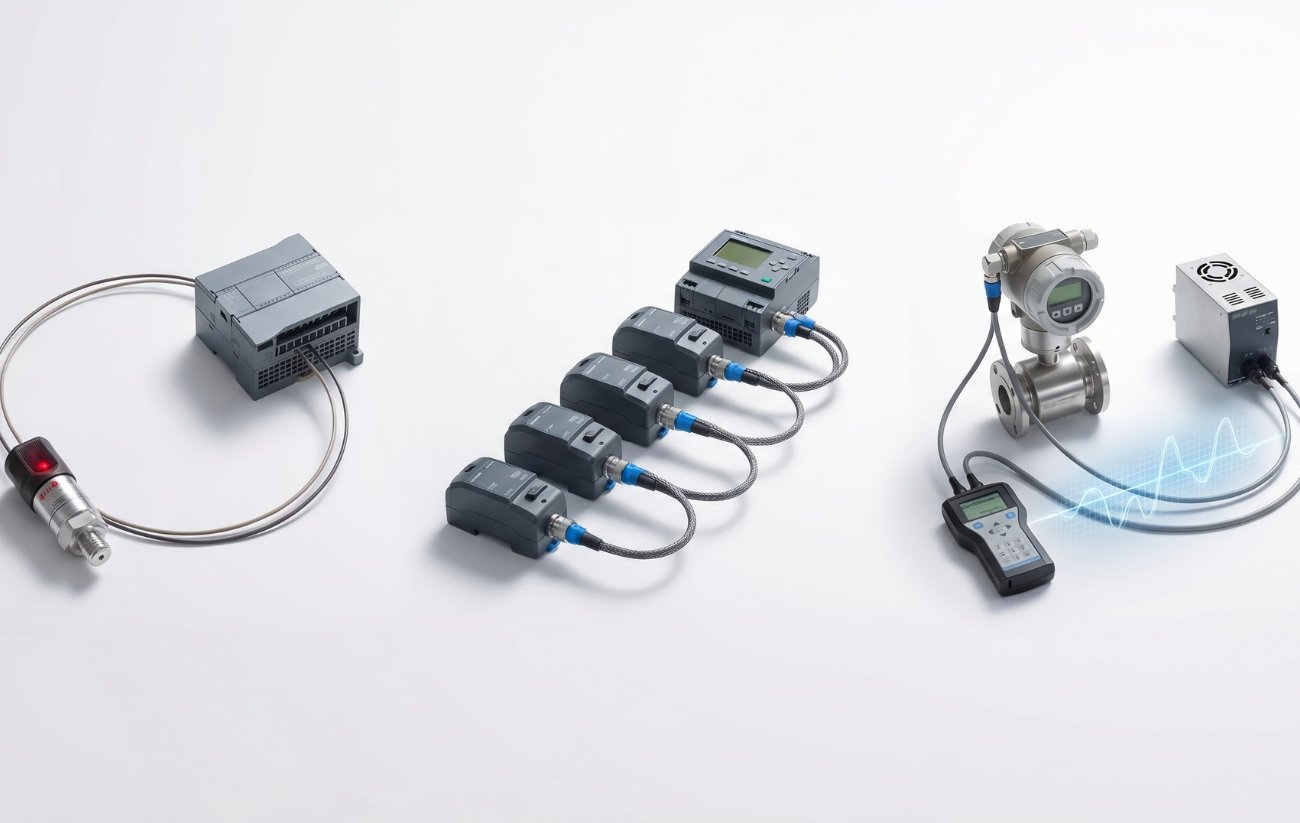
✔️ Simple pressure sensor
→ 4–20 mA
✔️ Smart transmitter
→ 4–20 mA + HART
✔️ Modern SCADA system
→ Modbus
Conclusion – what to choose
There is no universal solution.
👉 The correct choice depends on the application:
- 4–20 mA → maximum reliability
- HART → balance between analog and digital
- Modbus → modern automation