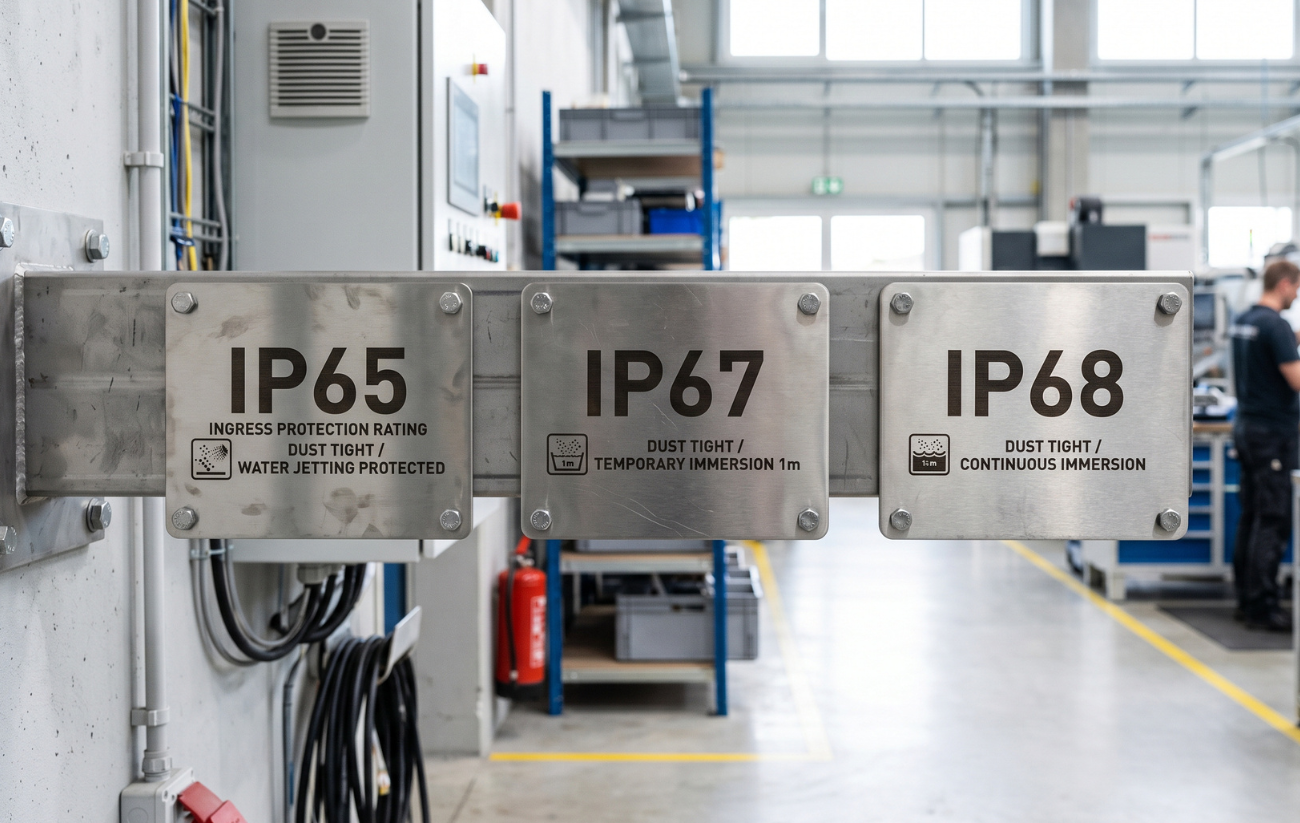
What Does IP65, IP67, IP68 Mean – Complete Guide for Industrial Equipment
Choosing the correct IP rating (Ingress Protection) is essential for the durability and reliable operation of industrial equipment. An incorrect IP rating directly leads to:
- equipment failure
- water or dust ingress
- high maintenance costs
- unplanned downtime
In this guide, you will clearly understand what IP65, IP67, and IP68 mean, the differences between them, and how to choose correctly for your application.
What is an IP rating
IP (Ingress Protection) is an international standard that indicates how well equipment is protected against:
- solid objects (dust, particles)
- water (rain, splashes, immersion)
The format is:
👉 IPXY
- X = protection against solids
- Y = protection against water
First digit – protection against dust
| Code | Protection |
|---|---|
| 0 | No protection |
| 5 | Protected against dust |
| 6 | Completely dust-tight |
👉 For industrial use:
✔️ IP65, IP67, IP68 = high dust protection
Second digit – protection against water
| Code | Water protection |
|---|---|
| 5 | Water jets (strong splashing) |
| 7 | Temporary immersion (up to ~1 meter) |
| 8 | Continuous immersion (defined by manufacturer) |
IP65 – protection against water jets
What IP65 means
- completely protected against dust
- resistant to water jets from any direction
Where IP65 is used
- outdoor equipment
- industrial areas without direct water contact
- electrical panels
- sensors mounted on pipelines
IP65 limitations
- NOT suitable for immersion
- not recommended for areas with standing water
👉 Ideal for: standard industrial environments.
IP67 – protection against temporary immersion
What IP67 means
- complete dust protection
- resistant to temporary immersion in water up to ~1 meter
Where IP67 is used
- equipment exposed to heavy rain
- areas with risk of temporary flooding
- more demanding outdoor environments
IP67 limitations
- not suitable for continuous immersion
- depends on actual operating conditions
👉 Ideal for: outdoor applications with water exposure.
IP68 – protection for continuous immersion
What IP68 means
- fully dust-tight
- resistant to continuous immersion in water
👉 IMPORTANT:
Depth and duration are defined by the manufacturer.
Where IP68 is used
- level sensors in tanks
- submersible equipment
- applications in water or extremely humid environments
IP68 limitations
- specifications vary by manufacturer
- not all IP68 ratings are the same
👉 Ideal for: submerged and extreme environments.
IP65 vs IP67 vs IP68 – quick comparison
| Feature | IP65 | IP67 | IP68 |
|---|---|---|---|
| Dust protection | Complete | Complete | Complete |
| Water protection | Water jets | Temporary immersion | Continuous immersion |
| Typical use | Standard outdoor | Wet environments | Submersible applications |
How to choose the correct IP rating
1. Analyze the environment
- dry indoor → IP54–IP65
- outdoor → IP65–IP67
- water / immersion → IP68
2. Evaluate real risks
- rain → IP65
- water jets / washing → IP65+
- flooding → IP67
- underwater → IP68
3. Avoid over-specifying
👉 Common mistake: choosing IP68 unnecessarily
Result:
- higher cost
- no real benefit
Common mistakes
- choosing IP65 for areas with standing water
- confusing “water-resistant” with “submersible”
- ignoring real operating conditions
- assuming all IP68 ratings are identical
Practical examples
✔️ Sensor on a pipeline indoors
→ IP65 is sufficient
✔️ Outdoor equipment
→ IP67 recommended
✔️ Sensor inside a tank
→ IP68 required
Conclusion – which IP rating to choose
There is no universal IP rating.
👉 The correct choice depends on the application:
- IP65 → standard industrial environments
- IP67 → outdoor and high humidity conditions
- IP68 → immersion and underwater applications