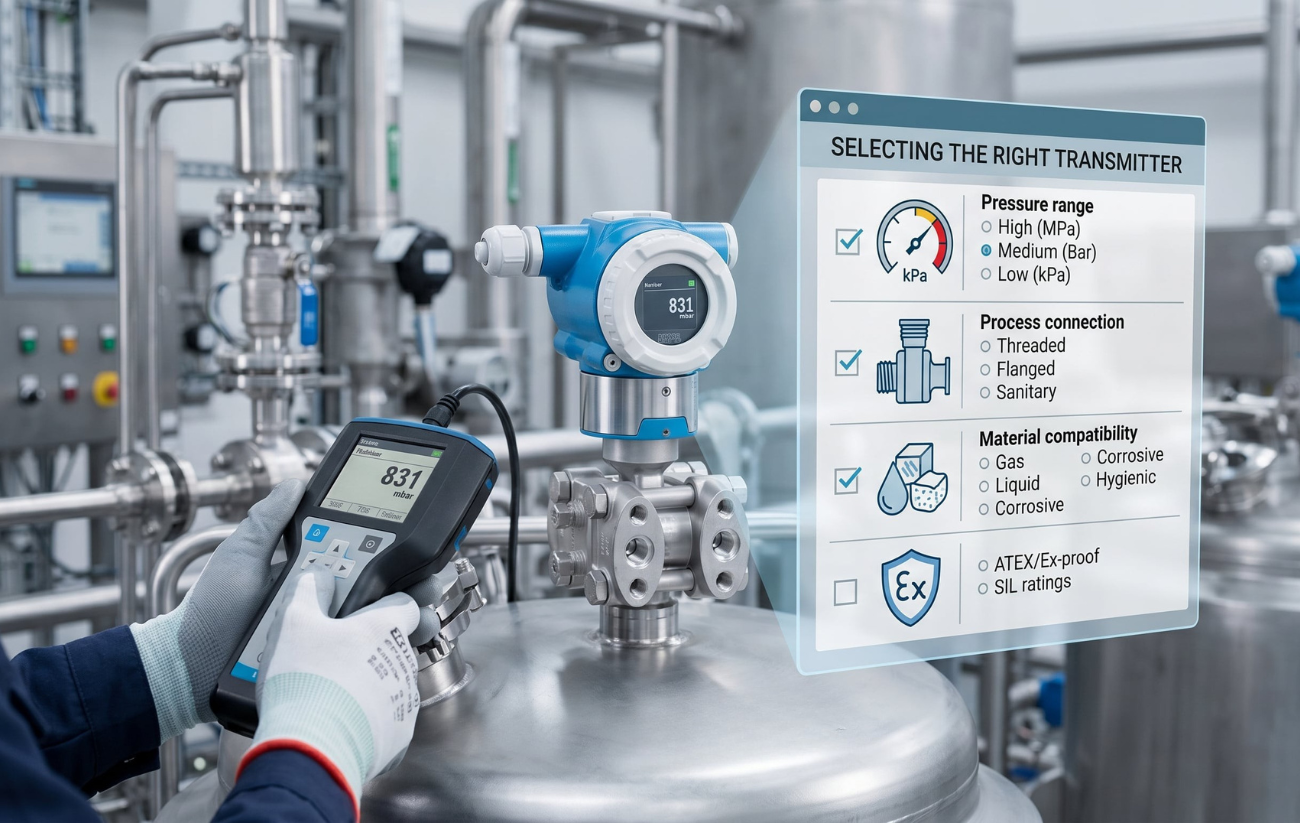
How to Choose the Right Pressure Sensor for Your Application – Complete Guide
Choosing the right industrial pressure sensor (pressure transmitter) is critical for the safe and efficient operation of any process. A wrong selection directly leads to:
- inaccurate measurements
- unplanned downtime
- equipment failure
- product losses and high costs
In this guide, you will clearly understand the types of pressure sensors, the differences between them, and how to choose correctly based on your industrial application.
What is a pressure sensor and why is it important
A pressure sensor measures the pressure of a fluid (liquid or gas) and converts it into an electrical signal (typically 4–20 mA, HART, Modbus), transmitted to PLC/SCADA systems.
Equivalent terms used in industry:
- pressure sensor
- pressure transmitter
- pressure transducer
Its role is essential for:
- process control
- safety
- consumption optimization
Types of pressure sensors – key differences
1. Absolute Pressure
Measures pressure relative to absolute vacuum (0 bar).
Applications:
- vacuum processes
- pharmaceutical industry
- laboratory
Recommended when atmospheric pressure affects the process.
2. Gauge Pressure
Measures pressure relative to atmospheric pressure.
Applications:
- most industrial applications
- water, compressed air
- HVAC systems
This is the most commonly used type of pressure sensor.
3. Differential Pressure
Measures the difference between two pressure points.
Applications:
- flow measurement (with orifice plates)
- filters (clogging monitoring)
- level measurement (in closed tanks)
Essential in complex systems.
How to choose the correct pressure sensor
1. Type of application
- water / air → gauge pressure
- vacuum → absolute pressure
- filters / flow / level → differential pressure
2. Measurement range
Critical rule:
Choose a sensor with a range ~20–30% higher than the maximum actual pressure
Example:
- process = 10 bar
- recommended sensor = 16 bar
Avoid:
- under-range → sensor damage
- over-range → loss of accuracy
3. Working environment
Analyze:
- temperature (high / low)
- vibrations
- humidity
- corrosive environment
For aggressive environments:
- stainless steel (316L)
- special protections
- diaphragm seals
4. Type of fluid
- clean liquids → standard
- viscous liquids → diaphragm type
- corrosive fluids → special materials
- gases → specific sensors
The fluid directly affects sensor lifetime.
5. Output signal type
Most common:
- 4–20 mA → industrial standard
- HART → communication + configuration
- Modbus / digital → advanced integration
For most applications:
✔️ 4–20 mA + HART = optimal choice
6. Mechanical connection type
- threaded (G1/2, G1/4)
- flange
- clamp (food industry)
Choose based on the existing installation.
7. Protection rating (IP)
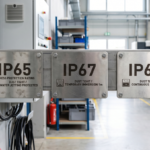
- IP65 → indoor
- IP67 / IP68 → humid environments / outdoor
Very important for durability.
Types of pressure sensors by technology
Piezoresistive
- most commonly used
- good price/performance ratio
Capacitive
- very accurate at low pressures
- ideal for differential pressure
Strain gauge
- general industrial applications
Common mistakes in pressure sensor selection
- wrong type selection (absolute vs gauge)
- incorrect measurement range
- ignoring process temperature
- choosing incompatible materials with the fluid
- neglecting vibrations
These mistakes lead to:
- rapid failure
- inaccurate measurements
- high costs
Practical examples
Water in a pipeline
→ gauge pressure sensor + 4–20 mA
Closed tank
→ differential pressure sensor
Vacuum system
→ absolute pressure sensor
Conclusion – how to choose correctly
There is no “best pressure sensor.”
There is only:
- the right sensor for your application
- or a wrong choice that costs money
Quick recommendations:
- standard applications → gauge pressure
- critical applications → full analysis + consulting
- harsh environments → robust industrial equipment