How to Choose a Temperature Sensor (RTD vs Thermocouple) – Complete Industrial Guide
Choosing the right industrial temperature sensor is essential for any technological process. A wrong selection directly leads to:
- inaccurate measurements
- equipment failure
- product losses
- additional maintenance costs
In this guide, you will clearly understand the difference between RTD and thermocouple, when they are used, and how to choose correctly based on your application.
What is a temperature sensor and why is it important
A temperature sensor measures and transmits the temperature of a process to the control system (PLC, SCADA, DCS).
In industry, the most commonly used types are:
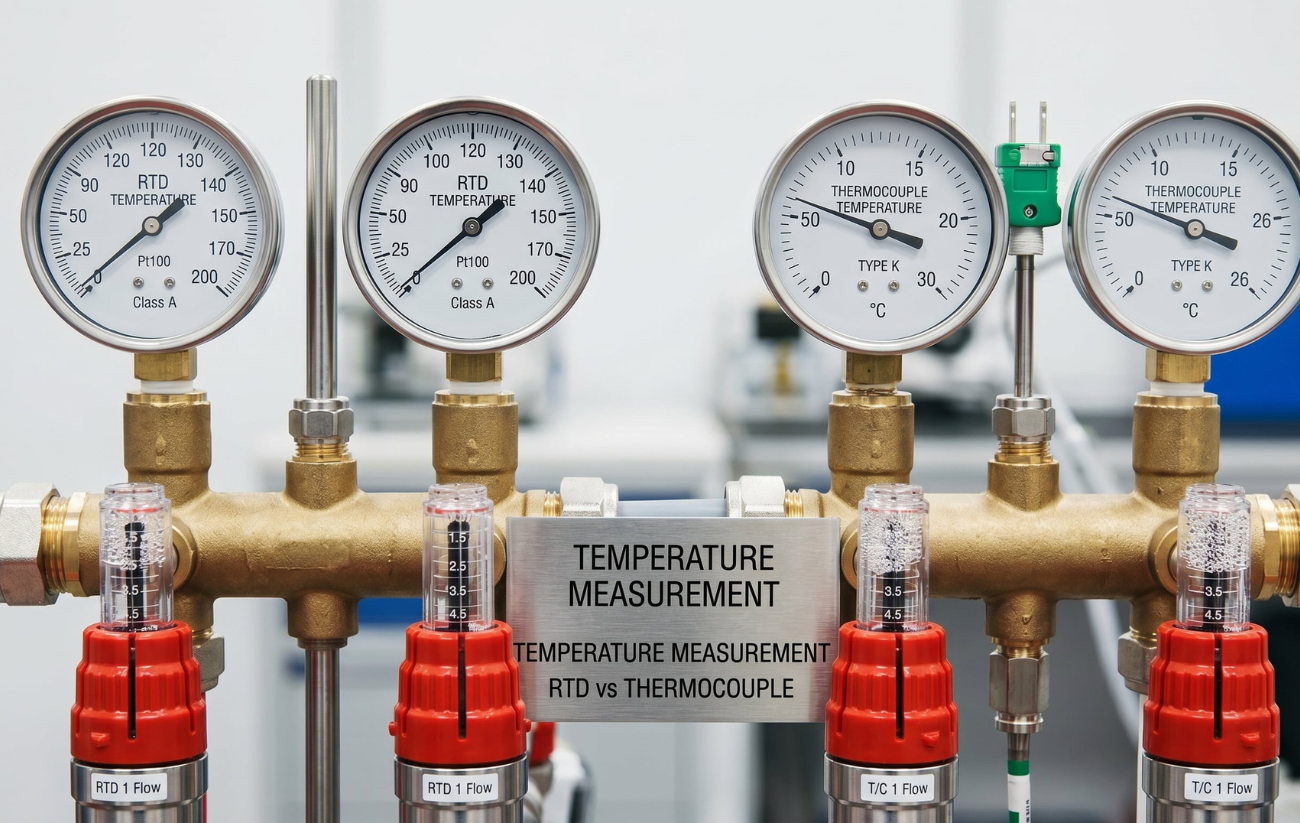
- RTD (Resistance Temperature Detector) – e.g., PT100, PT1000
- Thermocouple – e.g., type K, J, T
The choice between them is NOT random — each has a clearly defined role.
RTD (PT100 / PT1000) – high accuracy for stable applications
How RTD works
RTD operates based on the variation of electrical resistance of a metal (usually platinum) depending on temperature.
The most commonly used is PT100 (100 ohms at 0°C)
Where RTD is used
- food industry
- pharmaceutical industry
- HVAC systems
- processes requiring high accuracy
RTD advantages
- very high accuracy
- excellent long-term stability
- high repeatability
- ideal for precise temperature control
RTD limitations
- limited temperature range (generally up to ~600°C)
- slower response time
- more sensitive to vibrations
Thermocouple – resistance to extreme temperatures
How a thermocouple works
A thermocouple generates an electrical voltage when two different metals are joined and exposed to temperature (Seebeck effect).
Where thermocouples are used
- industrial furnaces
- metallurgical processes
- chemical industry
- applications with very high temperatures
Thermocouple advantages
- withstands very high temperatures (up to 1800°C depending on type)
- fast response time
- high mechanical resistance
- suitable for harsh environments
Thermocouple limitations
- lower accuracy than RTD
- requires cold junction compensation
- drifts over time
RTD vs Thermocouple – direct comparison
| Characteristic | RTD (PT100) | Thermocouple |
|---|---|---|
| Accuracy | Very high | Medium |
| Maximum temperature | ~600°C | Up to 1800°C |
| Response time | Slower | Fast |
| Stability | Very high | Medium |
| Shock/vibration resistance | Sensitive | Very resistant |
| Cost | Higher | More affordable |
How to choose the correct temperature sensor
1. Process temperature
- below 400–600°C → RTD (PT100)
- above 600°C → Thermocouple (type K, J, etc.)
2. Required accuracy
- critical applications → RTD
- general industrial applications → Thermocouple
3. Working environment
- stable environment, no vibrations → RTD
- harsh environment, vibrations, shocks → Thermocouple
4. Response time
- precise control → RTD
- fast reaction → Thermocouple
Popular types of temperature sensors
RTD
- PT100 (most commonly used)
- PT1000 (for more stable signal over long distances)
Thermocouple
- Type K (most universal)
- Type J (general industrial use)
- Type T (low temperatures)
Common mistakes in sensor selection
- choosing RTD for very high temperatures
- using thermocouples where high accuracy is required
- ignoring environmental conditions (vibrations, humidity, pressure)
- incorrect probe type selection (immersion, surface, etc.)
These mistakes lead to direct costs and production downtime.
Conclusion – RTD or Thermocouple?
There is no universal sensor.
The correct choice depends on the application:
- RTD (PT100) → accuracy, stability, precise control
- Thermocouple → extreme temperatures, harsh environments, fast response